
Mental Rumination: What It Really Means and Why Your Mind Won’t Let Go

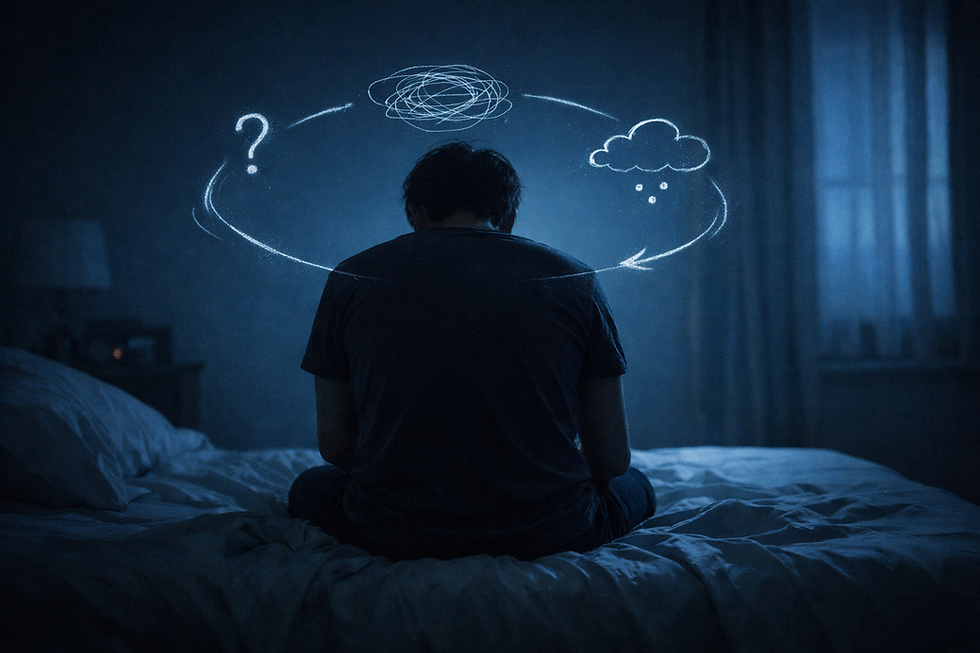
If you’ve ever replayed the same moment in your head until it felt worn thin… You already know what mental rumination feels like.
It’s lying awake at night re-running a conversation you wish had gone differently. It’s mentally time-traveling to the future to prepare for something that hasn’t happened yet. It’s the sense that your mind is working overtime, yet nothing actually resolves.
Most people call this “overthinking.” Psychology calls it something more precise.
Mental rumination.
And once you understand what that word actually means, the experience starts to change, not because the thoughts vanish, but because you finally see the pattern for what it is.
What Mental Rumination Really Means
Mental rumination is a pattern of repetitive, circular thinking where the mind keeps returning to the same thoughts, emotions, or scenarios without moving toward clarity or action.
The key feature isn’t negativity. It’s stagnation.
You’re thinking, but you’re not progressing. The thoughts don’t evolve. They orbit.
Psychologists describe rumination as passive mental replay, often focused on distress, uncertainty, regret, or perceived mistakes. The mind stays busy, but relief stays out of reach.
The term itself comes from the idea of “chewing over” the same material again and again. And just like chewing food that’s already been digested, mental rumination offers diminishing returns.
Why Rumination Feels So Personal (and So Hard to Stop)
Here’s the part most people miss: rumination doesn’t feel broken. It feels necessary.
Your brain is trying to protect you.
When something feels emotionally or psychologically unresolved, the brain flags it as important. It keeps bringing the thought back, hoping repetition will lead to safety, certainty, or control.
Except it doesn’t.
Instead, the same emotional charge reactivates. Again. And again. And again.
What’s Actually Happening in Your Brain
During rumination, a network in the brain called the Default Mode Network stays switched on.
This network is responsible for self-reflection, memory, imagination, and identity. It’s what allows you to learn from experience. But when it gets stuck, it turns inward, looping the same story without updating it.
That’s why rumination feels so convincing. The brain isn’t malfunctioning. It’s over-functioning.
Why Rumination Isn’t the Same as Thinking
Productive thinking moves somewhere. Rumination doesn’t.
Reflection brings insight, decisions, or emotional release. Rumination brings familiarity. The same questions. The same answers. The same tension.
And because it feels like effort, the mind mistakes it for progress.
That’s the trap.
Common Triggers That Pull the Mind Into Loops
Rumination often shows up when something touches a deep nerve:
Regret about the past
Fear about the future
Shame, embarrassment, or self-doubt
Uncertainty you can’t resolve right now
The mind keeps circling because it believes something important is at stake—your safety, your belonging, your sense of self.
Why Letting Go Can Feel Dangerous
Rumination creates the illusion of control. As long as you’re thinking, it feels like you’re doing something.
Letting go can feel like giving up, even when holding on is exhausting.
That’s why telling yourself to “stop thinking” rarely works. The brain interprets that as a threat.
When Rumination Starts Affecting Mental Health
Occasional rumination is normal. Chronic rumination is different.
When thought loops become constant, they can fuel anxiety, deepen depression, disrupt sleep, and drain emotional energy. The mind becomes loud, but life feels muted.
This doesn’t mean you’re weak. It means your nervous system has learned a pattern that no longer serves you.
Why Naming Rumination Changes Everything
Before you have a word for it, rumination feels like you.
After you name it, it becomes something your mind is doing.
That distance matters.
Because once you can see the loop, you’re no longer trapped inside it, even if it still shows up.
Products / Tools / Resources
Mindfulness & meditation apps designed to interrupt repetitive thought cycles
Cognitive Behavioral Therapy (CBT) workbooks focused on rumination and thought patterns
Somatic or nervous system–based practices that reduce mental looping by calming the body
Journaling frameworks that move thoughts from replay into resolution


