
Black Seed Oil Benefits: A Practical Guide to Its Uses, Potential Benefits, and Everyday Wellness
- VitaHolics

- 3 hours ago
- 7 min read
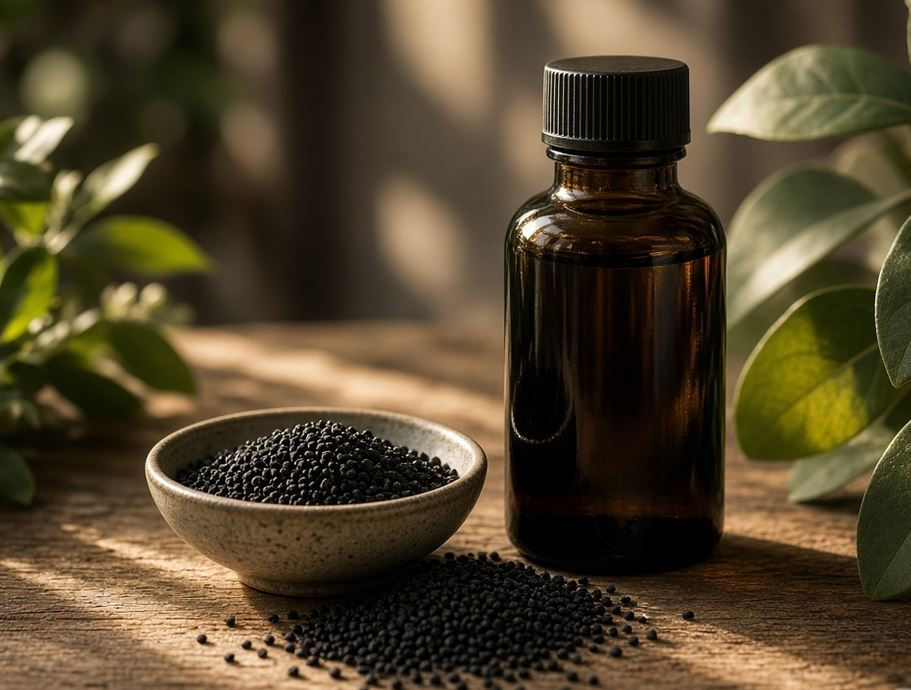
Black seed oil is one of those wellness ingredients that seems to turn up everywhere—from supplement bottles and kitchen cabinets to facial oils and hair-care products.
But popularity doesn't necessarily answer the most important question: what are the real black seed oil benefits, and does it make sense to use it as part of an everyday wellness routine?
Black seed oil comes from the seeds of Nigella sativa, a flowering plant with a long history of traditional use in parts of the Middle East, North Africa, and Asia. Modern researchers have also taken an interest in the plant, particularly in compounds such as thymoquinone.
There is some interesting science here, but there is also plenty of marketing noise. Black seed oil isn't a miracle cure, and research into its potential benefits is still developing.
Understanding the difference can help you make much better decisions about how—and whether—you use it.
What Is Black Seed Oil?
Black seed oil is pressed or extracted from the seeds of Nigella sativa. You may also see the plant referred to as black cumin or simply black seed.
The oil has a distinctive smell and a peppery, somewhat bitter taste. That's one reason capsules are attractive to people who want to avoid taking the oil directly.
Its chemistry is also part of the reason for the attention it receives. Black seed oil contains several naturally occurring compounds, including thymoquinone, which has been studied for antioxidant and other biological activities.
That doesn't mean every bottle of black seed oil will produce the same effects.
Growing conditions, seed variety, extraction method, processing, and storage can all influence the finished product. So when reading research about Nigella sativa, it's worth remembering that the exact preparation matters.
Black Seed Oil Benefits People Are Exploring
Search for black seed oil online and you'll find an enormous list of claimed benefits.
Some have a reasonable scientific rationale behind them. Others are based primarily on traditional use, preliminary research, testimonials, or marketing.
That's why it's useful to think about black seed oil in categories rather than treating every claim as equally established.
Antioxidant Properties
One of the most frequently discussed aspects of black seed oil is its antioxidant activity.
Compounds in Nigella sativa, particularly thymoquinone, have been studied for their interaction with oxidative processes in laboratory and other research settings.
This helps explain the oil's reputation as a wellness ingredient.
Still, there's an important distinction between demonstrating biological activity and proving a specific health benefit in people. Those are not the same thing.
Skin and Beauty Uses
Black seed oil has also found a place in skincare.
You'll see it included in facial oils, moisturizers, cleansers, and other personal-care products. Its natural oil content makes it appealing as part of a moisturizing routine, while its botanical compounds have contributed to interest in its cosmetic applications.
If you're applying pure black seed oil to your skin for the first time, start cautiously. A small patch test is a simple way to see how your skin responds.
And be skeptical of claims that one ingredient can automatically “treat” a skin condition. Cosmetic use and medical treatment are very different things.
Digestive and General Wellness
Black seed has a long history of traditional use, including in connection with digestion.
Modern research has explored Nigella sativa in a range of health contexts, but that doesn't turn the oil into a guaranteed treatment for digestive complaints.
If you're experiencing persistent bloating, pain, reflux, changes in bowel habits, or another ongoing symptom, the more useful question is usually what's causing it—not which supplement might mask it.
How to Use Black Seed Oil
For most consumers, the decision comes down to two formats: liquid oil or capsules.
Neither is inherently the right choice for everyone.
Liquid Black Seed Oil
Liquid oil gives you more flexibility.
Depending on the specific product, it may be used in food or taken according to the manufacturer's supplement directions. The strong flavor can be an advantage or a drawback, depending on your taste.
One important detail: check the label.
An oil designed for topical use isn't automatically suitable for eating, and a culinary product isn't necessarily formulated as a dietary supplement.
Black Seed Oil Capsules
Capsules are probably the simplest option for people who don't enjoy the flavor of the oil.
They also make serving sizes straightforward. Instead of measuring liquid, you simply follow the serving information on the label.
However, capsule products vary. Look at the actual amount per serving rather than assuming that two products containing the same number of capsules are equivalent.
Making It Part of a Routine
If you decide to use black seed oil, simplicity is your friend.
Adding one new product at a time makes it easier to notice how your body responds. Follow the manufacturer's directions and resist the temptation to increase the amount just because you don't notice an immediate effect.
A supplement doesn't need to feel dramatic to be part of a routine—and a negative reaction shouldn't be ignored simply because the product is marketed as “natural.”
Black Seed Oil for Skin and Hair
Black seed oil isn't limited to the supplement aisle.
It's increasingly common in beauty products, particularly those aimed at skin and hair.
Using It on the Skin
You can find black seed oil in facial oils, creams, cleansers, and other topical formulations.
If you're using a pure or highly concentrated oil, introduce it gradually. Avoid the eye area and patch test first, particularly if you have sensitive skin.
It's also worth separating cosmetic expectations from medical ones. An ingredient can be perfectly reasonable as part of a personal-care routine without being proven to treat a specific dermatological condition.
Hair and Scalp Care
Black seed oil also appears in hair oils and scalp products.
Some people use botanical oils as part of conditioning or moisturizing routines. Claims that black seed oil will automatically stimulate hair growth or resolve scalp disorders deserve more scrutiny, however.
If you're dealing with significant hair loss, persistent itching, inflammation, or other scalp symptoms, professional evaluation is a better starting point than relying solely on an oil.
How to Choose a Quality Black Seed Oil
Walk into the supplement or wellness aisle, and you'll probably see plenty of options.
The packaging can make them look dramatically different, but the label is often more useful than the branding.
Organic and Cold-Pressed
Two terms you're likely to encounter are organic and cold-pressed.
Organic refers to agricultural production standards. Cold-pressed describes an extraction approach.
Both may matter to individual buyers, but neither word alone proves that one product is the best choice for a particular purpose.
Look at the whole picture: ingredient transparency, intended use, serving information, storage instructions, expiration information, and the manufacturer's reputation.
Read the Label Carefully
A good product should make it reasonably clear what you're purchasing.
For a supplement, check the serving size, amount of black seed oil per serving, and other ingredients.
For a topical product, confirm that it's intended for external use.
Storage matters too. Oils can degrade when repeatedly exposed to heat, light, and air. Keeping the product according to the manufacturer's instructions can help preserve its quality.
Black Seed Oil Dosage and Safety
This is one area where a cautious approach makes sense.
There isn't one universal black seed oil dosage that applies to every person or every product. Different studies use different preparations and amounts, and commercial products have their own instructions.
More Isn't Necessarily Better
It's easy to fall into the supplement mindset that a larger amount must produce a larger benefit.
That's not a safe assumption.
Concentrated botanical products can have biological effects, and taking more may increase the likelihood of unwanted effects without providing a corresponding benefit.
Start with the product's directions rather than experimenting with increasingly large amounts.
Possible Side Effects and Precautions
Black seed products may cause side effects in some people, including digestive discomfort or allergic reactions.
Extra caution is appropriate in certain circumstances. If you're pregnant or breastfeeding, taking prescription medications, preparing for surgery, or considering the product for a child, speak with an appropriate healthcare professional first.
The same applies if you have an existing health condition that could make supplement use more complicated.
“Natural” doesn't automatically mean risk-free, and supplements can interact with medications or affect biological processes.
Black seed oil should complement—not replace—appropriate medical care.
Frequently Asked Questions
What is black seed oil used for?
Black seed oil is used for general wellness, culinary purposes, skincare, and hair care. Nigella sativa has also been investigated in scientific research for a variety of biological and health-related effects.
Is black seed oil the same as black cumin oil?
The terminology can be confusing. Black seed oil generally refers to oil from Nigella sativa, a plant also associated with the name black cumin.
The easiest way to verify a product is to check for the botanical name Nigella sativa on the label.
Is black seed oil better than capsules?
Not necessarily.
Liquid oil offers versatility and can work well for people who don't mind its strong flavor. Capsules are convenient and easier for people who prefer not to taste the oil.
The best format is largely a matter of intended use and personal preference.
Can I put black seed oil on my skin?
Black seed oil is commonly included in topical skincare products.
If you're using pure oil, patch test first and stop if irritation occurs. Avoid applying concentrated oil near the eyes.
How quickly does black seed oil work?
There isn't one reliable timeline.
Research studies vary in duration, preparation, and outcomes, while individual experiences can differ. Be particularly cautious of marketing claims promising dramatic results after only a few days.
Is black seed oil safe for everyone?
No supplement is universally appropriate for everyone.
People taking medications, pregnant or breastfeeding individuals, children, and people with relevant medical conditions should seek professional advice before using a concentrated botanical supplement.
Products / Tools / Resources
Black seed oil in liquid form for people who prefer flexible use.
Black seed oil capsules for convenient, measured servings.
Cold-pressed black seed oil for consumers interested in extraction methods.
Organic black seed oil for those prioritizing organic agricultural standards.
Ingredient-label and supplement-quality resources for comparing products responsibly.


